How to Choose a Compliant UN 2814 Bag for Safe Shipping?
Choosing a UN 2814 bag is not just a purchasing decision. It is one part of a tested packaging system for Category A infectious substances affecting humans. The bag alone does not establish compliance. The complete package must meet the applicable requirements, including Packing Instruction P620, for the shipment’s mode and route.
Use authoritative references, not product claims alone. The World Health Organization’s Guidance on Regulations for the Transport of Infectious Substances, 2023–2024, explains classification and packaging principles. IATA’s Dangerous Goods Regulations provide air-transport requirements and are updated regularly. Check the editions that apply to your shipment. Rules can change.
Look for clear manufacturer documentation, compatible primary and secondary receptacles, suitable absorbent material, and a rigid outer package with the required performance-tested design. Check dimensions, closures, and instructions against the actual contents; a small mismatch can matter. Labels help, but labels alone are not proof. Details matter.
A useful selection review asks whether the bag is designed for the intended packaging configuration, whether its documentation is traceable, and whether trained staff can assemble and inspect it consistently. Do not assume that “UN 2814 ready” on a sales page is enough. That claim needs checking. WHO and IATA guidance should be read alongside the current applicable regulations and the manufacturer’s instructions. When any detail is unclear, pause and consult a qualified dangerous-goods professional before shipping.
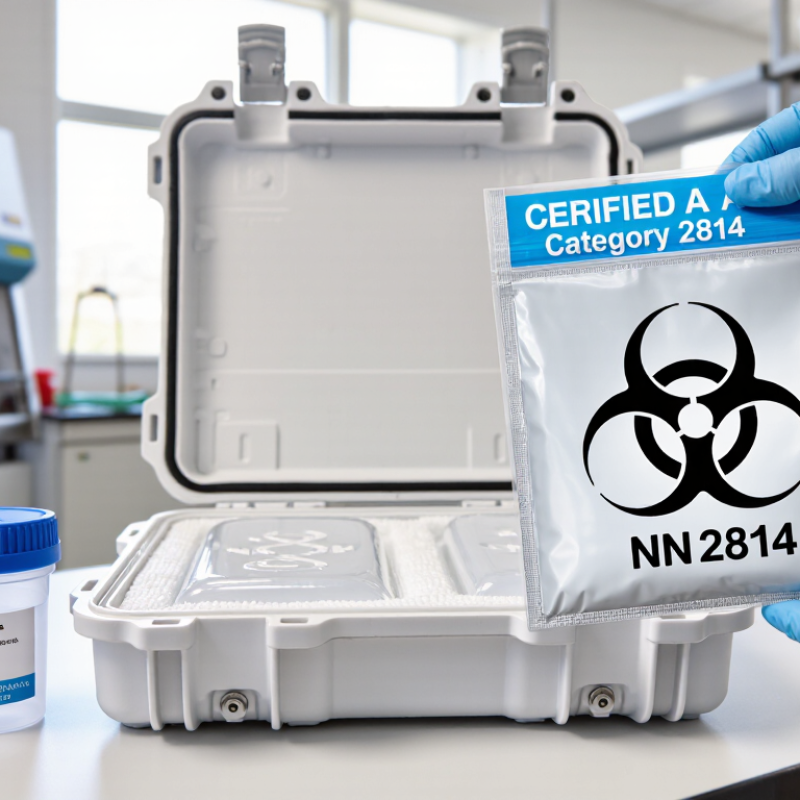
Classify the agent as UN 2814 Category A under applicable rules
Classify the material before selecting a UN 2814 bag. UN 2814 applies to infectious substances in Category A that affect humans, including substances affecting both humans and animals. Under the UN Model Regulations and IATA Dangerous Goods Regulations, classification depends on the agent’s known or reasonably expected ability to cause severe disease after exposure. Consider laboratory findings, clinical details, and the source of the specimen. When information is incomplete, seek a qualified dangerous-goods or biosafety professional’s assessment. A familiar label is not enough.
The bag alone does not make a shipment compliant. Category A shipments require a P620-compliant packaging system: a leakproof primary receptacle, leakproof secondary packaging, and a rigid outer package. IATA’s P620 requirements include a pressure-differential resistance of at least 95 kPa for the primary or secondary packaging. UN Model Regulations packaging tests also include a 9-metre drop test for applicable package designs. These figures are practical checks, not a substitute for verifying the complete package design and current rules. That distinction matters.
Choose a bag only if it is specified for its role in the tested system, with enough space for absorbent material when shipping liquids. Check closure integrity, puncture resistance, and compatibility with the specimen and temperature conditions. Keep classification records and confirm the shipper’s training and documentation requirements. The difficult part is often the evidence: specimen details may be incomplete, and a quick assumption can be wrong. Recheck before dispatch.
Select a UN-tested P620 package rated for a 95 kPa pressure differential
For UN 2814 shipments, choose a complete package tested to P620—not just a bag marked “UN.” The package should include the tested combination of primary receptacle, leakproof secondary packaging, and rigid outer packaging. Each part matters. A compliant bag cannot compensate for an unsuitable outer container.
Check that the package’s test documentation specifies a pressure differential of at least 95 kPa and applies to the exact configuration you plan to use. Confirm the permitted contents, closures, and packing arrangement. Keep the instructions available for packing staff. A small mismatch, such as a different closure, can undermine the tested setup. A label alone is not proof.
Tips: Inspect bags and seals for punctures, creases, or contamination before use. Follow the package maker’s assembly instructions, and do not substitute components casually. It is easy to focus on the pressure figure and overlook the rest. That deserves a second check.
Build triple containment with leakproof primary and secondary receptacles
For UN 2814, a bag is only one part of the packaging system. Use a leakproof primary receptacle, a leakproof secondary receptacle, and a strong, rigid outer package. This is triple containment. For liquid specimens, place enough absorbent material between the primary and secondary receptacles to absorb the full contents if a leak occurs. Keep the primary container upright when practical, and protect it from movement or impact.
Choose a bag designed for the intended role and compatible with the complete packaging configuration. A standard plastic bag does not, by itself, make a shipment compliant. Check that closures remain secure, the secondary receptacle has no holes or weak seams, and the outer package protects the contents during handling. One detail is easy to overlook: a well-sealed inner container can still fail if it shifts inside the box. Confirm the current UN 2814 packing requirements and required package markings before dispatch.
Tips: Place a small amount of liquid in a sample container and check its closure before packing. Don’t guess. If the package configuration or instructions are unclear, ask a qualified dangerous-goods shipping professional.
How to Choose a Compliant UN 2814 Bag for Safe Shipping?
Build triple containment with a leakproof primary receptacle and leakproof secondary packaging.
Key check: Under Packing Instruction P620, the primary receptacle or the secondary packaging must be capable of withstanding a pressure differential of at least 95 kPa without leakage. UN 2814 shipments also require triple packaging: a primary receptacle, secondary packaging, and a rigid outer packaging. Follow the applicable regulations and packaging instructions for the specific shipment.
Check P620 performance: 9 m drop and 3 m stacking for 24 hours
Choosing a UN 2814 bag starts with the test record, not its color or thickness. Under P620, performance applies to the complete packaging configuration, not a bag considered on its own.
The 9 m drop test challenges the assembled package against impact from a significant fall. Seals, closures, absorbent material, and the outer packaging all matter. A strong-looking bag is not proof of compliance. That detail is easy to miss.
The 3 m stacking test checks whether the packaging can withstand a representative load for 24 hours. Ask whether the tested design matches the package you plan to use, including its materials and closure method. Small changes can matter.
Check the supplier’s test documentation and inspect each bag for punctures, weak seams, or damaged closures before packing. Keep the package dry and follow the documented assembly steps; hurried handling can undo careful selection.
Tips: Confirm both test results. Match the tested configuration. Replace damaged bags. Don’t guess. If a detail is unclear, pause and verify it with a qualified dangerous-goods professional before shipment.
Verify Class 6.2 labels, UN 2814 marks, and carrier documentation
A UN 2814 bag is only one part of the packaging system. UN 2814 identifies an infectious substance affecting humans, and the shipment falls under Class 6.2. Check that the package—not just a loose bag—shows the required Class 6.2 hazard label and the UN 2814 mark. Both should be clear, durable, and visible on the outer package. A bag can look sturdy and still be unsuitable.
Verify the complete packaging configuration against current transport rules and the applicable P620 requirements. Check that inner receptacles are securely closed, cushioning and absorbent material are in place where required, and the rigid outer packaging is intact. Small details matter. A folded label or a mark hidden beneath tape can cause delays. I have seen how easy it is to focus on the container and overlook the paperwork.
Before handover, compare package details with the carrier’s current acceptance checklist. Confirm required dangerous goods declarations, transport documents, and any carrier-specific forms for the chosen route and mode. Names, quantities, and package counts should agree across records. Requirements can vary, so confirm them with a trained dangerous goods professional or the carrier before dispatch. That final check can feel repetitive, but it is worth doing.

 +86 178 5514 5298
 CONTACT NUMBER
 CONTACT NUMBER